
Calling All Baby Bird Feeders!
We are drafting next summer’s baby bird feeder schedule, so let us know if you’d like a 4-hour shift once a week from mid-May through August.
Please fill out this form with your available days of the week and preferred time slot, or if you’d like to be on the substitute feeder list.
Baby Bird Feeder Information
Baby birds require a tremendous amount of care, sometimes needing to be fed every half-hour all day long! Help the Center for Wild Bird Rehabilitation care for hundreds of orphaned or abandoned birds this summer.
Baby bird feeder volunteers care for patients from 8 AM – 8 PM every day of the week from May to August. The day is split into three shifts 8 AM-12 PM, 12 – 4 PM, and 4 – 8 PM.
Open to youth ages 10 to 17 with an adult mentor alongside them during all shifts. Adults are also welcome to participate in this program on their own.
Requirements: In the height of summer there is a very high volume of baby birds needing care. Baby bird feeding requires the ability to stand and crouch frequently. It is not suitable for adults or children who become easily overwhelmed. Baby bird feeders must also have the dexterity to hold and use tweezers and small syringes properly for feedings.
There will be a mandatory virtual training via Zoom for all baby bird feeder volunteers in April.
Commitment: Requires a weekly commitment of 4 hours from May – August (up to 2 scheduled absences allowed). Adult mentors should plan to cover for the child during the end of the school year and if the child is away at a summer camp.
NEW! Hotline & Admissions Volunteer
VINS will be trying out a new volunteer position for the busy season! This is a seasonal position (May-September), with a similar time commitment as other positions (3-4 hours, once a week).
Hotline & Admissions Volunteer Description
Want to help out in a wildlife hospital, but don’t want to get your hands dirty? The Hotline & Admissions Volunteer position is focused on answering incoming calls for the Wild Bird Hotline, consulting with staff on how to handle various wildlife situations, coordinating transport of injured, sick and orphaned birds, and greeting and collecting stories and information from finders. Volunteers will ideally have customer service or hotline experience, enjoy speaking with the public about birds and other wildlife, have the ability to follow a call guide, and use sound judgement for when staff should be consulted about calls.
There will be an online training in the spring. Please contact Erica at etucker@vinsweb.org if you are interested in this position and we’ll add you to the training list!
Wanted: Photos of Volunteers in Action!
Do you have a great shot of a VINS volunteer in action? Please send it to Erica at etucker@vinsweb.org. We’d like to share the great work you do with our members and donors. Thank you!
2026 Special Event Dates & Volunteering Opportunities
With the New Year comes another year of special events at the VINS Nature Center! The dates for some of the big events happening on-site this year are listed below, and if you are interested in participating and supporting any of these events, mark your calendar and reach out to Mya at mwiles@vinsweb.org for details. Events with asterisks* are particularly in need of volunteer support, but we are happy to have help during any event.
- Saturday, February 21 – Winter Wildlife Celebration
- Saturday, April 25 – Owl Festival*
- Saturday, June 13 – Remarkable Reptile Day
- Saturday, July 11 – Incredible Insect Festival
- Saturday, August 22 – Forest Fairy Festival*
- Saturday, September 26 – Magnificent Mammal Day
- Saturday, October 24 – Hoots & Howls*
Center for Wild Bird Rehabilitation
Ongoing Intake Numbers/Species & Current Patient Numbers
We took in 1,177 birds in 2025 and generally have about 20-30 patients in care during the winter months.
Other Interesting News and Intakes
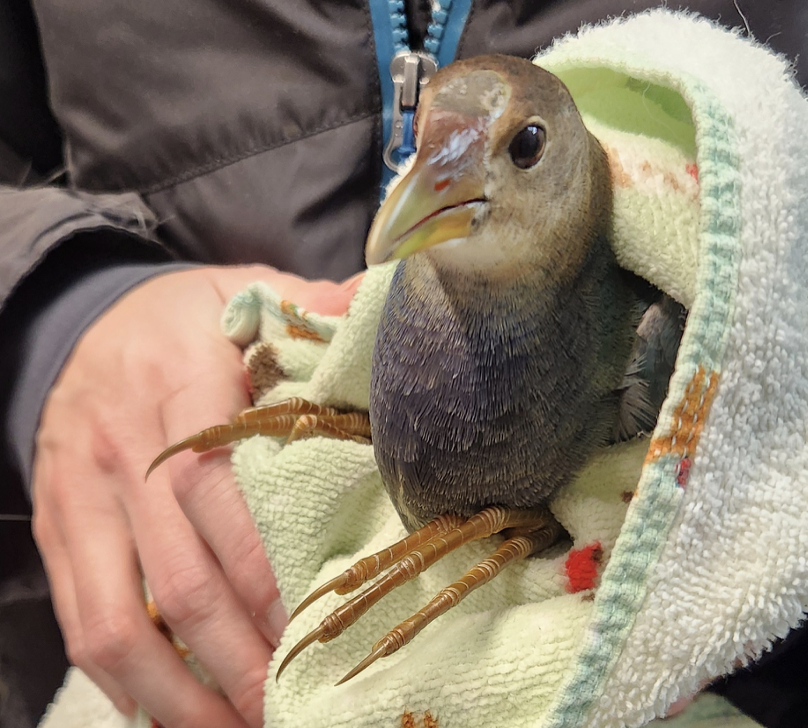
Most of our patients are Barred Owls and winter songbirds, especially birds that frequent bird feeders. Our most interesting patient by far is a Purple Gallinule, whose native range is Florida and farther south. We aren’t sure how it ended up in Vermont, but they are known for showing up in unusual places. We’re currently working on figuring out transport for it back down to Florida.
Photo: Purple Gallinule
Rehab Fact: Avian Malaria
When you think of malaria, you probably think of the tropics – after all, that’s where humans can be infected. For birds though, malaria is worldwide, present on every continent except Antarctica (at least for now). Birds across the world have evolved with dozens of malaria species, and most of the time are only subtly affected. However, changing infection and environmental dynamics have altered this balance, sometimes in dramatic ways. Invasive malaria has caused the extinction of about a third of Hawaii’s honeycreeper species since the late 1800’s, and other introduced strains, global warming and environmental toxins have made malaria infections more dangerous over time. But before we get into how it affects Vermont’s birds, what exactly is malaria?
Malaria is caused by a single celled parasite in the genus Plasmodium, that has a complex life cycle involving both mosquitoes and vertebrate hosts. Briefly, an infected mosquito bites a bird, human, or other animal, and the parasites are transmitted in the saliva. They initially undergo asexual reproduction in tissue cells, then invade red blood cells. Once the blood is infected, gametes, the mature parasites, can be taken up by a mosquito to continue the infection cycle. A second form, called schizonts, develop into clusters of smaller forms called sporozoites, and when the schizont is mature it ruptures the red blood cell, allowing the sporozoites to spread and infect other red blood cells. Destruction of red blood cells leads to anemia, which can cause weakness, circulatory disorders and kidney damage. The red blood cell turnover also leads to a greatly enlarged liver and spleen, which can put pressure on the air sacs and contribute to respiratory difficulty. Somewhat unique to birds, tissue stages can also cause severe disease or death, particularly when the cells that line blood vessels become infected and swollen, which can lead to blockages that prevent blood flow to parts of the brain. Finally, immune compromise from malaria infection can lead to high rates (>40%) of severe bacterial and fungal coinfections, making treatment substantially more difficult.
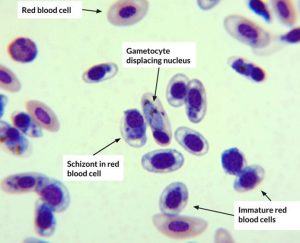
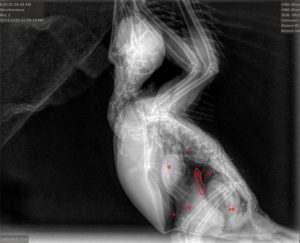
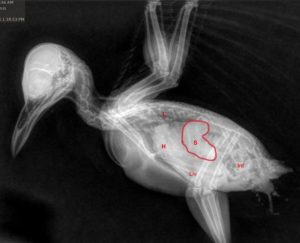
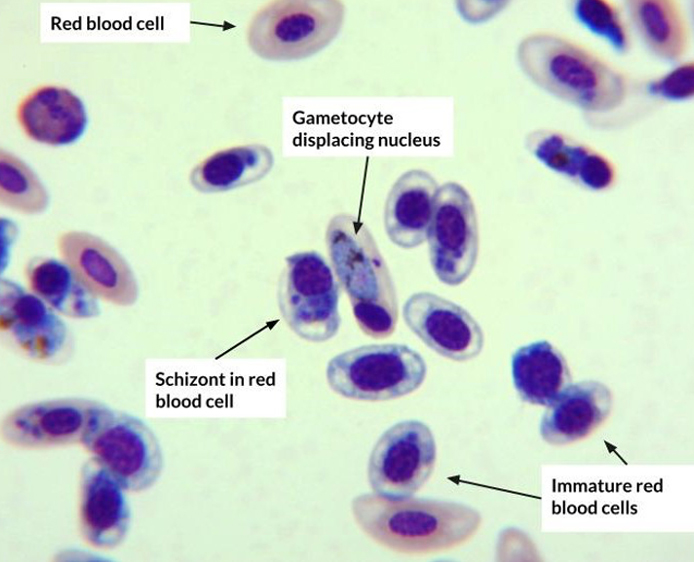
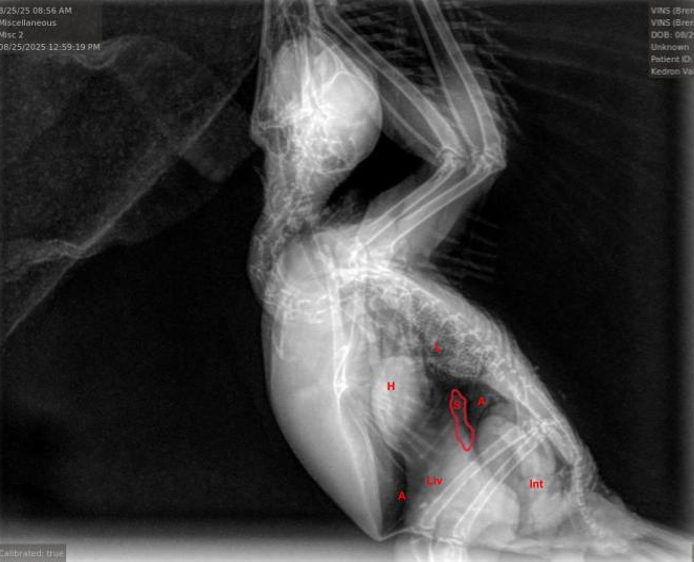
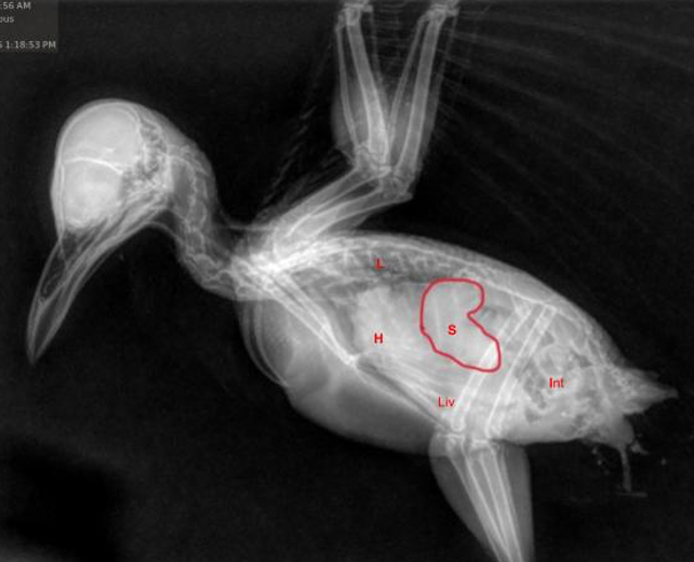
So what birds in Vermont are affected by malaria? It was first discovered in Northeastern common loons in 2017, and has caused mortalities each year, making it an emerging disease, although luckily it hasn’t seemed to cause major impacts so far. The more widespread effect is in passerines, which is where nearly all cases have been seen in CWBR. It is primarily a disease of juvenile birds, particularly American robins, corvids and grackles. In fact, in some years it is a leading cause of infectious disease deaths in robins, with 7 cases and 5 deaths in 2025- making it responsible for 25% of deaths in care for robins this year. I suspect that it is an underrecognized disease in juvenile passerines, for a variety of reasons: many rehabilitators either don’t or can’t do bloodwork on songbirds, or don’t perform necropsies regularly. Additionally, many field studies on malaria focus on breeding or migrating adults, and don’t focus on the population most vulnerable to infectious diseases- young birds. This has been an area of ongoing research for me, to better understand pathology in wild birds, improve ability to detect and identify coinfections, use these findings to guide treatments and ultimately to publish these findings and increase awareness about this significant disease of wild and rehabilitated birds.
Want to learn more? Contact Bren at blundborg@vinsweb.org.
Exhibit Ambassadors
Since the last newsletter, we have had a change in staffing: Spencer left VINS to pursue other opportunities, and I (Evan) have taken over! It has been very exciting and rewarding so far to work with the exhibit birds and reptiles. I will continue to make tweaks to improve quality of life for the ambassadors, and make changes that hopefully make our jobs streamlined and easier! A big thank you to all of the amazing volunteers, I truly could not do my job without all of you!
Ambassador Updates
Springfield and Waitsfield, the Broad-winged Hawks, have moved to their weather-protected enclosure for the winter, and Windham, our female Cooper’s Hawk, took their place. Similarly, LA, our Black Vulture, moved to her inside enclosure, and Bridport, the education Rough-Legged Hawk, moved outside. Springfield, Waitsfield, and LA have all been enjoying their new spaces safe from the cold weather! We have also been monitoring the weather, and taking Barnet, Bridgewater, Poultney, and Randolph (the Kestrels and Turkey Vultures, respectively) inside CWBR when the daily low is less than 10 degrees. As migratory species, they are not able to tolerate the super cold temperatures. Currently, they are outside, but it changes week by week!
We continue to assess our Northern Harriers, Addison and Erie, for signs of stress and discomfort. As you may have noticed, the tarp we put up around the summer time has been removed from the top of the Harriers enclosure. This was first put up in an effort to reduce Addison’s stress, as she had been repeatedly flying into the walls and ceiling, injuring herself. We thought that by making the enclosure darker, she might stay calmer. Now that we are in the less people dense winter season, we took the tarp down so they could enjoy the natural lighting, and to see how Addison reacted. They mostly have remained calm, and we will reassess in the spring if we will put the tarp back on, or if we can put any other solutions in place to keep them happy and stress free. Despite the lack of collisions in the enclosure, the two have become increasingly food motivated in the past few days. We increased their food amount and are keeping a very close eye on them to make sure they are behaving normally, and staying well fed.
Songbird Aviary
We have introduced Drumley, a new Dark-eyed Junco, and Johnson, a new Red-winged Blackbird. They both settled in nicely and are enjoying the free food and shelter. Unfortunately, one of the waxwings passed away at the end of November. Here is the up-to-date full list:
- 7 Remarkable Robins: Hanover, Plainfield, Montpelier, Middlebury, Piermont, Barre, Mystery
- 5 Magnificent Mourning Doves: Washington, Plymouth, Windsor, Crafts, Bethel
- 4 Courageous Cedar Waxwings: Main, Occom, Fay Brook, Vermont
- 3 Charismatic Cardinals: Rutland, Reservoir, Lisbon
- 2 Precious Purple Finches: College & Killington
- 2 Graceful Goldfinches: Newbury & Hazen
- 2 Wonderful White-Throated Sparrows: Danville & West Bradford
- 1 Heartwarming House Finch: Christian
- 1 Terrific Tree Sparrow: Essex
- 1 Superb Song Sparrow: Etna
- 1 Beautiful Bluebird: Canaan
- 1 Distinguished Dark-Eyed Junco: Drumley
- 1 Rambunctious Red-Winged Blackbird: Johnson
Reptile Ambassadors
Earlier in November, we welcomed our newest edition to the team, Maize! She is a lovely 6 year old corn snake (gray morph, so looks much different compared to Millie & Willie) who loves to play and explore. She was rehomed to us after her family could not take care of her anymore. Right now, we are working on handling her and getting her used to us. The plan is for her to become an ambassador snake, filling in for Wilmington since he is retired now. Maize lives in the commissary and loves visitors, so feel free to stop by and see her (and maybe handle her)! In other news, Turt has settled into her new tank nicely, and is loving the extra space! Wilmington had x-rays done earlier in the week to re-assess his arthritis. Bren noted that it doesn’t look any worse, which is an okay sign. We continue to monitor him and make sure he feels comfortable in his older age.
Snowy Owl Highlight
A big birthday milestone will be coming up this September for Snowy, when she will be turning 20! Snowy and LaGuardia have been enjoying the cooler weather and the snow it has brought. Something interesting to note about Snowy Owls as a species is that this year appears to be an irruption year for them. Irruption years occur usually every 3-5 years as a result of an abundant supply of food during the previous summer. All the food means lots of babies, and come fall, they migrate south for more plentiful resources, and then return back north for the breeding season.
Please feel free to contact me at erinaldi@vinsweb.org if you have any questions or comments!
Education Ambassadors
Training Milestones
As we wrap up the busy summer season and transition into the winter months, our training also shifts from outdoor activities to indoor ones. Meaning, more flying with our owl ambassadors! Being indoors gives us a safe, consistent environment to offer our owls the chance to exercise both physically and mentally while demonstrating their amazingly quiet flight. One ambassador in particular is a great flier, if not sometimes easily startled: St. Louis the American Barn Owl. She is fully flighted and can fly confidently across the room and to some of her favorite perches. So long as no one opens the doors or drops a water bottle that is. But as her trainers, when we noticed she was easily spooked by sudden noises, we wanted her to have a way to safely remove herself from what she perceived as “scary”. And we worked with her on a seemingly obvious solution: just go back to your crate! Now whenever St. Louis gets nervous or is startled, she flies straight backstage to her crate where she can choose to come back out to finish her flights, or stay in her crate and work on other behaviors later. This is a great way to demonstrate to the public during programs the nature of choice-based training with our birds. If St. Louis is not comfortable out on stage, she knows she can fly back to her crate and her choice to leave will be respected by her handlers.
Highlighting Ferrisburgh, Our American Kestrel
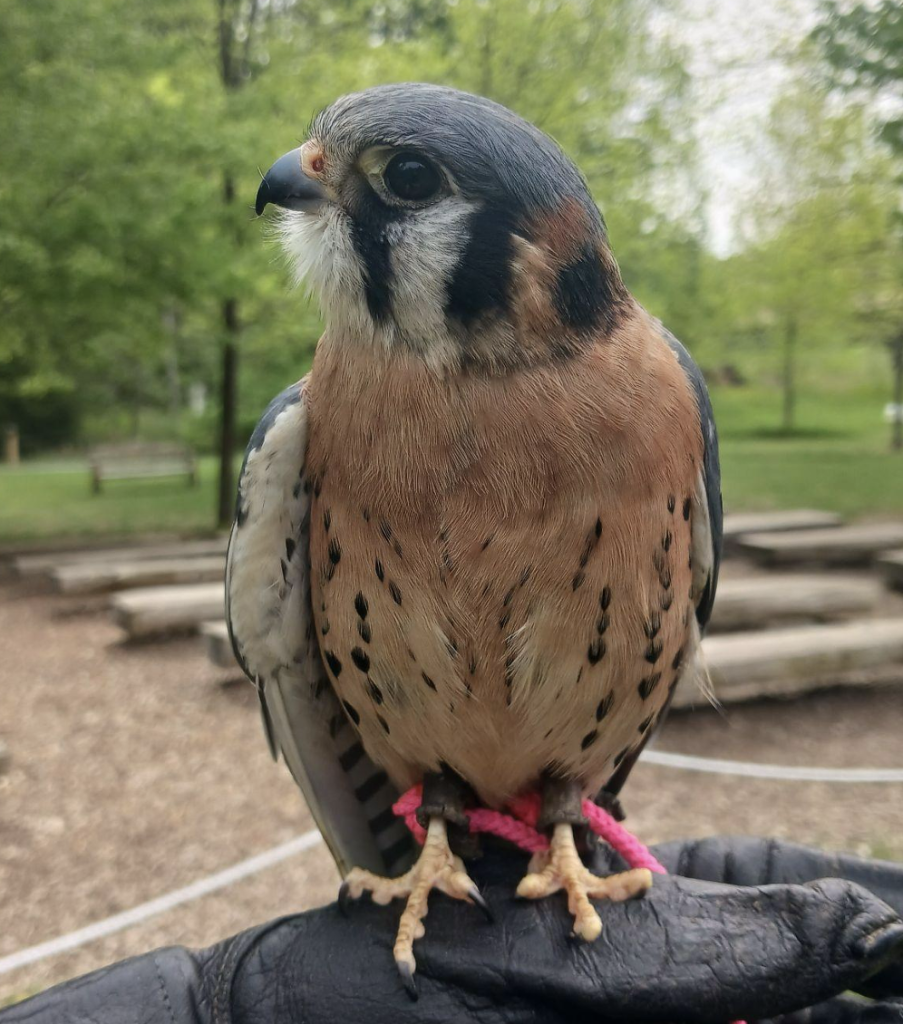
Ferrisburgh was brought to the Center for Wild Bird Rehabilitation in 2019 after making a habit of landing on people and begging like a chick to any human that would pass by. Based on this report and his behavior once in the care of our rehabilitators, it was quickly determined that he must have been illegally raised by humans and had been imprinted in the process. We obviously do not know who or why someone picked up a young American Kestrel and decided to bring it home rather than call their local rehabilitators, but they must have raised him in their home and released him when he appeared to be fully grown.
Photo: VINS Ambassador Ferrisburgh, American Kestrel
Unfortunately, once out in the wild he did not know how to hunt for himself, so he found the nearest humans to land on and beg for food, resulting in his capture and transfer to us. Now, Ferrisburgh is an amazing ambassador for his species as he is very comfortable being around humans. He is a great way to introduce to visitors why taking wildlife home is not the best idea, as he frequently begs his handlers for food like a young baby kestrel does to their parents, despite being an adult. His loud vocalizations, colorful plumage, and bright personality make him a quick favorite of visitors and staff alike, and his brief artistic career landed him in a few well-known magazines!
Raptor Fact! Speed in Falcons
Falcons are known for performing a steep hunting dive called a “stoop,” during which they can achieve incredible speeds to strike and kill prey. Few scientific measurements have been taken on birds of prey in their stoops, but here’s what we definitively know about these amazing birds:
- Peregrine Falcon (Falco peregrinus) – 242 miles per hour
- Skydiving with Peregrine Falcon (Video, National Geographic)
- Smithsonian Magazine article – Peregrine Falcon
- Gyrfalcon (Falco rusticolus) – 156 miles per hour
- A theoretical falcon – 389 miles per hour
Ask the Trainers
How do you teach the birds to fly?
We don’t! What? Expecting a longer answer? Well, I suppose you really meant to ask how we train our flighted ambassadors to do flights during programs, as us humans have no advice to offer a bird on the inner mechanics of avian flight.
We can offer flighted birds opportunities to fly and chances to build muscles and skills that they need to fly confidently. If an ambassador is already comfortable stepping onto the glove and hanging out for food, they know that a raised glove means snack time! So all we need to do is increase the distance between the bird and the glove cueing them so that they have to hop and flap their wings in order to make it to the glove for their reward. The distance of the cues can then gradually increase, and the location can change once they are confident in one space. Outdoors provides the most number of uncontrollable variables that a bird may have to deal with, including but not limited to: sun glare, gusty winds, high/low temperatures, human activity, sudden noises, and other wild animals.
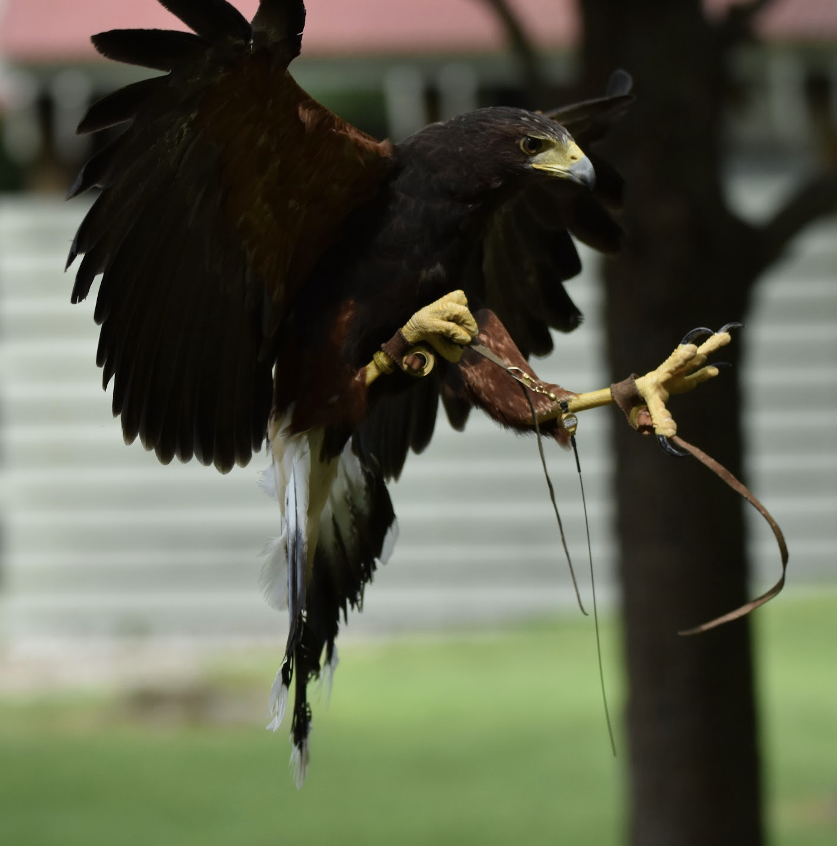
For example, in order for the Harris’s Hawk ambassadors to do their amazing over-audience flights in programs, they had to overcome a lot of extra background “noise” in order to focus on the handler’s cues. Imagine you are flying over a river of wiggly humans who turn and stare or duck and move quickly out of your way as you fly by. All that movement was really scary when they first started practicing, but overtime they grew to learn that wiggly humans are not a threat, and have not harmed them, so can be safely ignored.
Photo: VINS Ambassador Paige, Harris’s Hawk
Some things are still scary, like fast moving children running towards them, and strange strollers that seem to contain mysterious creatures and move unnaturally across the ground. But with practice and lots of positive experiences to balance out the scary ones, many of our ambassadors can stretch their wings and show off their flight skills!
If you have any specific questions about training, let us know and we can answer your questions in the next newsletter! Feel free to contact Mya at mwiles@vinsweb.org or Anna at amorris@vinsweb.org.
Fantastic Newsletter! Thank you!