
Transporter Virtual Training Now Available!
We need more volunteer transporters, and we have a new virtual, self-paced training.
Complete these 4 steps if you’d like to be on the transporter call list:
- Watch the one hour recording of the Transporter Training
- Complete this quiz to check your understanding of the video (must score 10 or higher)
- Fill out the Bird Transporter Information Form
- Complete the attached Volunteer Waiver Form and return it to etucker@vinsweb.org
When you have completed all 4 steps, you will receive confirmation from Erica that you are in our transporter database and we will contact you when there is a transport needed. Thank you for your dedication to volunteering to help the birds!
Calling All Volunteers!
Science Symposium / Friday, May 8
We also need help with the Science Symposium – greeting buses, setting up activity stations, guiding groups to their home base, and more!
Contact Kelly at kgadouas@vinsweb.org.
New! Hotline & Admissions Volunteer
The Hotline & Admissions Volunteer position is focused on answering incoming calls for the Wild Bird Hotline, consulting with staff on how to handle various wildlife situations, coordinating transport of injured, sick and orphaned birds, and greeting and collecting stories and information from finders. Volunteers will ideally have customer service or hotline experience, enjoy speaking with the public about birds and other wildlife, have the ability to follow a call guide, and use sound judgement for when staff should be consulted about calls.
Volunteers are needed mid-May through August in the mornings.
Contact Erica at etucker@vinsweb.org if you are interested in this position.
Volunteer Hours
Please submit your volunteer hours for our fiscal year (4/1/25 – 3/31/26)!
Here are the updated volunteer codes:
- 400 Nature Center (Special Events, Forest of Lights)
- 450 Education (Wildlife Ambassador Team, Public Programs, Nature Center Docent)
- 530 Camp (Leaders-in-Training)
- 550 CWBR (Baby Bird Feeding, Enclosure Animal Care, Bird Transport and Rescue)
- 555 Research (Owl and Hawk Banding, Butterfly Monitoring, Feeder Watch)
- 700 Buildings and Grounds (Painting, Raking, Snow Shoveling)
If you work with multiple departments on one day, split the hours into another day. (What I really need are your total hours per department, not hours per day.) If you don’t remember your exact hours, an estimate is fine.
Complete the Volunteer Timesheet and email it to etucker@vinsweb.org.
Upcoming Special Event Dates
Volunteer at our special events at the VINS Nature Center! View dates below:
- Saturday, June 13 – Remarkable Reptile Day
- Saturday, July 11 – Incredible Insect Festival
- Saturday, August 22 – Forest Fairy Festival*
- Saturday, September 26 – Magnificent Mammal Day
- Saturday, October 24 – Hoots & Howls*
*Events that are particularly in need of volunteer support.
If you are interested in participating and supporting any of these events, mark your calendar and reach out to Mya at mwiles@vinsweb.org for details.
In Memory
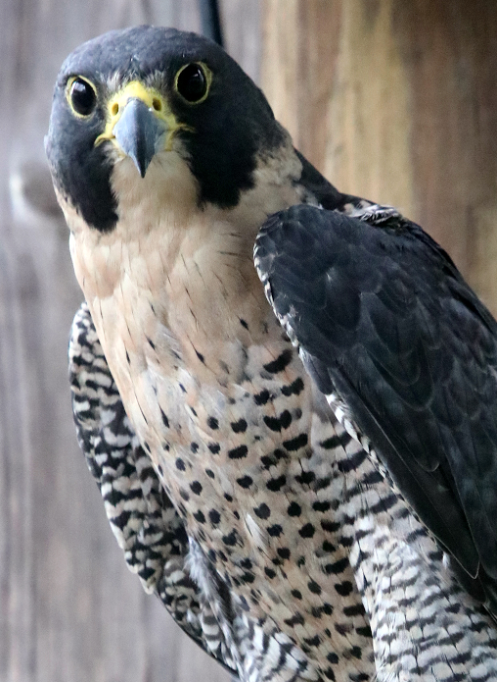
Fairlee, Peregrine Falcon
Losing an ambassador as charismatic as Fairlee is always challenging, so we wanted to honor her memory by talking about her.
As previously communicated, we came to the difficult decision to humanely euthanize Fairlee after she received a skin cancer diagnosis. We determined that the treatment options available to us would only provide short term results at best, in addition to providing poor quality of life and further stress that would be unfair to her.
Fairlee was with us since 2017, however, since she came to us as an adult we’re not aware of her exact age.
If you have any further questions about her or just want to share fond memories, contact Evan at erinaldi@vinsweb.org.
Photo: VINS Ambassador Fairlee, Peregrine Falcon
Exhibit Ambassador Updates
Health Checks
With much of the cold winter weather behind us, we look forward to the spring and the warm weather that will come with it. It is around this time of year that we hold our exhibit bird health checks. For our newer volunteers who aren’t informed, we do health checks twice a year to evaluate our resident birds’ health and check up on their injuries. It is a busy day requiring the help of lots of staff and volunteers to catch all the birds, weigh them, assess them, do a deep clean of the enclosures, and complete any enclosure projects like putting up new perches, platforms, etc.
We’ve completed our spring health checks, and the next round will take place this fall (October or November). If you’re interested in participating, contact Evan at erinaldi@vinsweb.org.
Northern Harriers
We also continue to closely watch our Northern Harriers, Addison and Erie. At the beginning of February, Addison was brought inside after she was found acting lethargic. After weighing her, it became clear she was underweight and that Erie was most likely stealing her food. Once she got back to a healthy weight, we put her back outside so we can see how she does. We are weighing her weekly, and at the time of writing this, she seems to be maintaining a healthy weight.
Songbird Aviary Updates
We currently have 30 songbirds in total:
- 6 Robins: Hanover, Plainfield, Montpelier, Middlebury, Piermont, Barre
- 4 Mourning Doves: Washington, Windsor, Crafts, Bethel
- 3 Cedar Waxwings: Main, Occom, Fay Brook
- 3 Precious Purple Finches: College, Killington, Websterville
- 2 Cardinals: Reservoir, Lisbon
- 2 Evening Grosbeaks: Weston, Landaff (both new!)
- 2 Goldfinches: Newbury, Hazen
- 2 White-Throated Sparrows: Danville, West Bradford
- 1 House Finch: Christian
- 1 Tree Sparrow: Essex
- 1 Song Sparrow: Etna
- 1 Bluebird: Canaan
- 1 Dark-Eyed Junco: Drumley
- 1 Red-Winged Blackbird: Johnson
It has been very fun watching the two new Evening Grosbeaks, Weston and Landaff. Evening Grosbeaks are highly social finches, so you can usually find them hanging out together munching on seeds or branches, or perching up high on the support beams. Our Red-winged Blackbird, Johnson, has also been wowing staff and visitors alike with his amazing songs and vocalizations.
We have also changed up the diet we feed the songbirds to be more well-rounded. In the past, the only fruit they were offered was grape (and occasionally blueberries), but I now offer them some combination of grape, blueberry, apple, banana, pear, and strawberry daily. For our Waxwings, who are frugivores, having a varied diet is very important so hopefully they are enjoying it!
We are also in the process of adding a pellet formula in addition to the seeds we offer to our seed eaters. A pellet formula is complete with fortified vitamins and minerals, making for a balanced diet. A seed diet (in captivity), on the other hand, can have nutritional gaps. In the wild this wouldn’t be an issue, since seed eating birds forage on a huge variety of seeds from native plants, but in captivity, the combination of commercially available seeds we can provide them can lend themselves to some nutritional deficiencies. For that reason, if you have ever compared our male cardinal to his wild counterpart, you’d find that our cardinal is much duller compared to a wild one. Hopefully by adding a pellet formula to the seed dishes, the overall health (and color) of our seed eaters will increase! We are also planning on transplanting some native grasses and vines into the aviary once it gets warmer to also provide more natural feeding options (and it will look prettier!).
Reptile Ambassador Updates
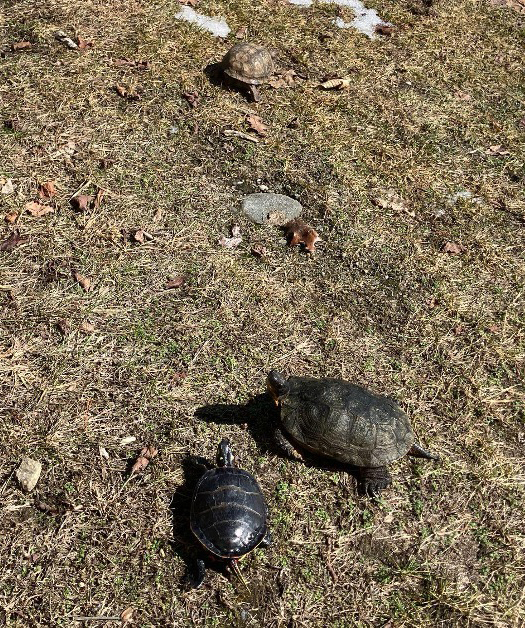
Our turtles have been enjoying the occasional outside time during sunny days lately!
On the topic of turtles, we’re in the process of updating the diets we feed them. Right now, they are all offered the same diet consisting of two protein sources, and a combination of either 2 veggies and 1 fruit, or 1 veggie and 2 fruits.
In the wild, box turtles (Jersey) and wood turtles (Turt) are more omnivorous, so they’d eat a variety of proteins, greens, and fruits, whereas painted turtles (Tippy) are more herbivorous, so they’d eat mostly greens and some protein. The diet we already feed them is mostly on track for Jersey & Turt, but Tippy’s diet will be tweaked to be more species appropriate.
Photo (top to bottom): Jersey, Turt, Tippy!
We are also going to try mixing in a multivitamin and calcium powder into their food to support overall health. This bunch of turtles can be picky and refuse new food items, so it might take some time, but I hope to get them set on their new diets soon!
Maize (or Brattleboro), our newest corn snake, has also been doing great! Since our last newsletter, she has attended a few programs here at VINS, and even went on an outreach event to a school. She is very social and overall is great to work with!
Ambassador Highlight
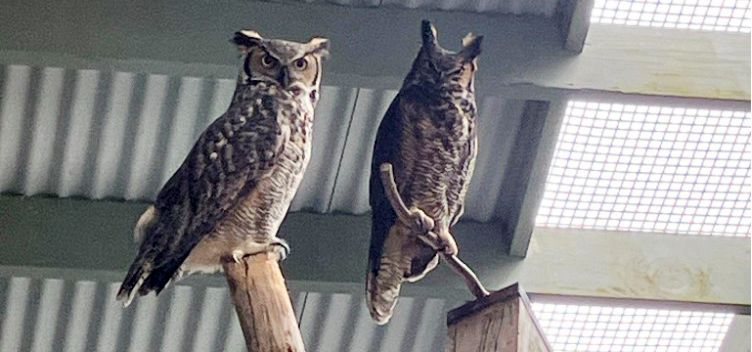
Whoooooo better to highlight this month than our Great Horned Owls, Nassau and Sullivan! If you have worked in their enclosure, you’d know Sullivan is a pretty relaxed bird who sticks to herself, while Nassau has a reputation for being a little…bolder.
This might come as a surprise to those who don’t know, but Nassau actually started at VINS as an education ambassador in 2017. She was originally rehabbed in Long Island after falling out of her nest as a juvenile, suffering from some head and eye trauma. According to Anna, at the time of her acquisition, we had plans to glove train her. The staff at the time quickly ran into trouble as she had issues balancing on the glove due to her injuries. Her training continued for about 2 years, but she never fully stepped onto the glove voluntarily, and therefore was moved onto exhibit in 2019. Sullivan, on the other hand, came to VINS in 2017 as a rehab patient with a left wing fracture of unknown trauma. Despite treatment, her wing didn’t heal fully so she became an exhibit ambassador.
Here’s a fun fact for our Volunteer Raptor Feeders:
Great Horned Owls are unique in the fact that they have a very early breeding season compared to other raptors, with egg laying happening some time around mid February to late March.
Highlighting Bridport, Our Rough-legged Hawk
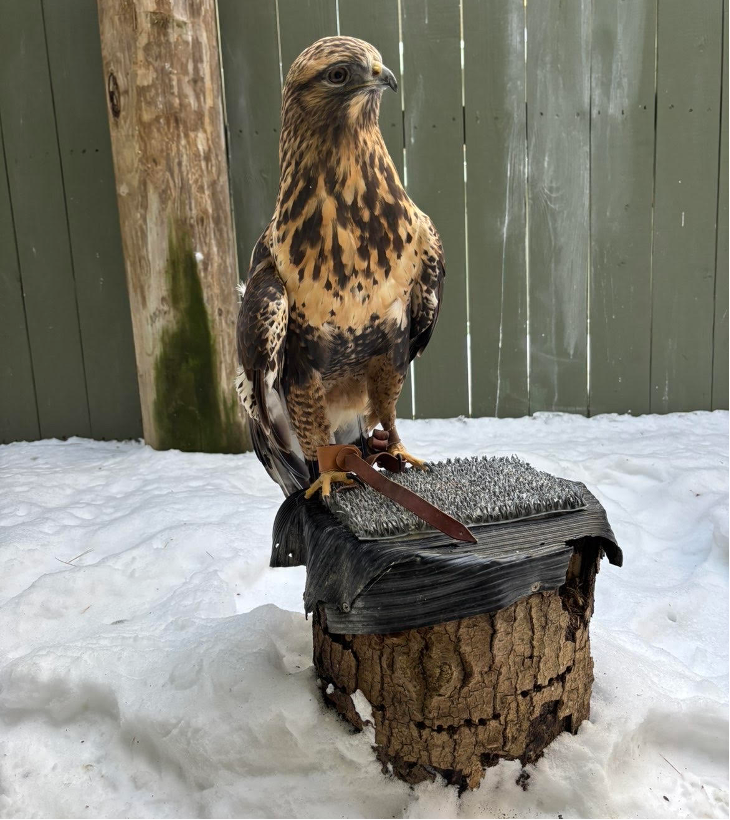
VINS Ambassador Bridport, Rough-legged Hawk
After being struck by a car in Bridport, VT during the winter of 2008, Bridport was brought to CWBR with a right elbow fracture that ultimately did not heal perfectly and limited her flight ability. She was deemed non-releasable and joined the education team where her trainers quickly fell in love with both her striking beauty and her unique personality.
Bridport now does amazing short-distance flights in programs, allowing us to highlight her arctic adaptations to the public. She is also unique in that she seasonally switches enclosures with Los Angeles the Black Vulture on exhibit, so that Bridport can enjoy the snowy winters outdoors and Los Angeles can enjoy the warm sunny summers outdoors. That means that everyone gets to see her at different times of the year!
Raptor Fact! Herbivory
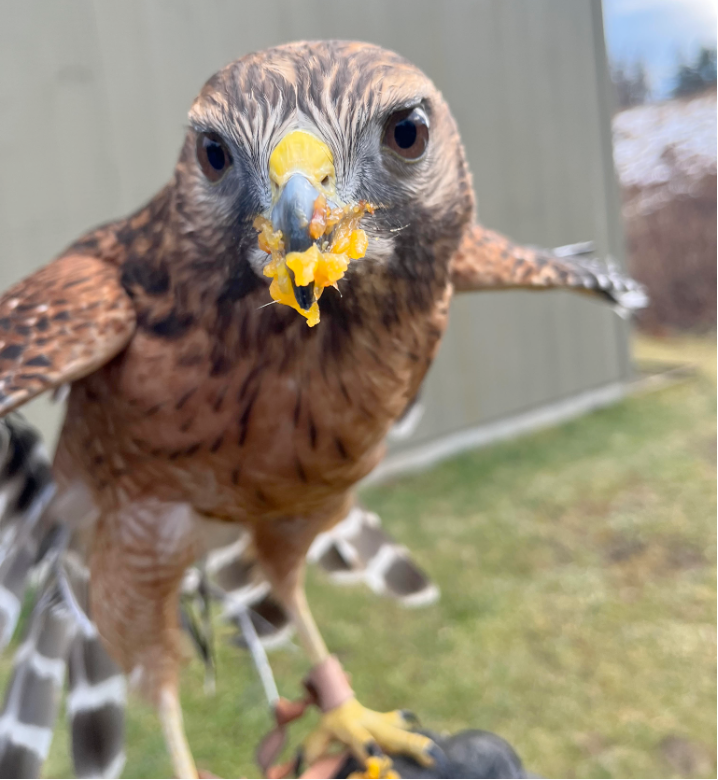
Herbivory? In our raptors? It's actually more likely than you think! While most birds of prey almost exclusively eat other animals, there are some exceptions where these so-called carnivores are observed consuming plant material.
While we don’t fully understand why a predator may decide to indulge in a fruit or vegetable on occasion, we can make some guesses about the nutritional needs of those individuals based on the specific type of plant they are consuming, and if it appears to be a regular occurrence, or simply a one-off observation. Below are just a selection of examples of raptors from across taxa consuming plants. Given the diversity of the kinds of raptors and of the plants they consumed, it is likely that this phenomenon is more common than we previously assumed. Perhaps there is really no such thing as a true carnivore or herbivore after all!
Interesting reads:
Literature Review of Raptors & Frugivory (Fruit-eating), 2021
Red-shouldered Hawks, Black Kites, Whistling Kites & Avocados
Photo: VINS Ambassador Ithaca, Red-shouldered Hawk, enjoying an egg on glove.
Ask the Trainers!
Can birds recognize individual humans?
Yes! There are many anecdotal examples of birds living with or alongside humans who clearly display behaviors that indicate they are able to differentiate between a human they have seen before and one that they have not. In addition to these anecdotes however is a list of published scientific work documenting and trying to understand if and why birds can learn to recognize humans.
Likely the most famous experiment involving avian recognition of humans involved American Crows on a university campus in Oregon. Crows were captured and banded by masked researchers, who later would walk around the campus and record the behavior of the crows who observed them. These crows not only scolded just the masks of the banding researchers, but crows who did not witness the original incident would also scold the same masks. This trend lasted for years after the initial experiment, displaying clearly that not only were the crows able to recognize specific human masks, but other naive crows could also learn which faces were dangerous without needing to have observed the danger first-hand. (Marzluff et al., 2010).
Another study tested a wild nesting population of Black-billed Magpies in Korea, where researchers either approached and climbed into an active nest tree, or just passed by, and later recorded behavioral responses of the magpies to those same individuals as they walked past the tree. The magpies would strongly scold the climbing humans but ignored the non-climbing humans, and even when both humans were present and walked around opposite sides of the tree, the magpies would preferentially scold just the climbers. The magpies were able to quickly learn to recognize individual humans and modify their behavioral responses based on previous experiences (Lee et al., 2009). A similar study on nesting Northern Mockingbirds found similar results of birds quickly learning to identify dangerous versus non-dangerous humans among thousands that pass by their nests on a university campus (Levey et al., 2009).
A study on pigeons in human care found that they were able to discriminate between familiar and unfamiliar humans, and even just images of those humans' faces. The pigeons were trained to select familiar objects during trials with non-human objects, then exposed to two humans, one that was completely unfamiliar to them, and another that they have seen and interacted with before. Pigeons in the experimental group were able to successfully select the familiar humans and their pictures, indicating that it is likely that birds may rely on some facial cues to identify individual humans. Interestingly, the familiar humans did not have exclusively positive or negative interactions with the pigeons, and were simply present to some capacity in/around their aviary. This may indicate that individual human recognition may not always be mediated by strong emotional responses, and may also be mediated by long-term exposure, at least for birds in human care (Stephan, Wilkinson, and Huber, 2012).
So we know for sure that birds across many taxonomic groups can absolutely learn to recognize individual humans, but how exactly do they recognize us? We humans generally recognize each other using facial features that we can see or hearing each other’s voice, but how do birds learn to differentiate us? We don’t really know! It is likely that they rely on some visual cues, but some may also use auditory cues as well. But what exactly are they looking at or listening for? That has yet to be fully explored and so is still an exciting avenue of research in avian cognition.
If you have any specific questions about training, let us know and we can answer your questions in the next newsletter! Feel free to contact Mya at mwiles@vinsweb.org or Anna at amorris@vinsweb.org.
I love reading this publication! Thank you so much for composing it!
Regarding raptor recognition of individual humans: I know that soke of you (staff) have indicated that you are pretty sure (completely sure?) that certain of the ambassador birds recognize certain individuals, as determined by? I wonder if there would be a way to do some work with the some of the exhibit birds to determine if there was recognition of specific individuals, e.g. do we know that some (or all) of the birds recognize Evan? or specific individuals among feeders or scrappers?
sorry about the typo in my last comment: “soke” should (obviously?) have been “some”